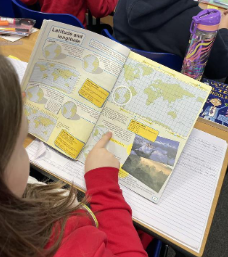
Welcome to our Geography learning
At Camelford Primary School we explore our local environment and research the wider world, we use enquiry and fieldword to study the human and physical processes and make sense of them. We want all our children to understand their place in the world, to be curious and ask questions about it's natural and human aspects. We offer opportunities to think about diversity, cultures and sustainability, and consider how our choices can affect the world around us.

The four main strands in the National Curriculum for geography are ‘locational knowledge’, ‘place knowledge’, ‘human and physical geography’ and ‘skills and fieldwork’. These are carefully mapped out in our geography pathway and progression statements (see link below):
 |
Geography Pathway |
Geography - Intent, Implementation and Impact
|
‘Geography explains the past, illuminates the present and prepares us for the future’ ‘What could be more important than that?’ Michael Palin |
|
Intent
At Camelford Primary School, our intent in geography is for pupils to be secure in their knowledge of both substantive and disciplinary content:
Substantive content is the substance that pupils learn in the subject – the building blocks of factual content. This geographical knowledge enables pupils to recognise the patterns, notice the contrasts, ask questions and discuss the options that the disciplinary content will demand.
In geography, the substantive knowledge and vocabulary is learnt through stories, descriptions, representations, reports, statistics and other sources.
Disciplinary content is all that pupils learn about how knowledge is constantly renewed in the subject’s ongoing development. This constant quest for a better understanding of our world inspires both awe and humility in pupils. The disciplinary aspect of the subject directly fosters the critical and creative aspects of learning. Pupils learn how to shape good geographical enquiries.
In studying geography as a discipline, pupils will: • think about geographical questions using concepts of place, scale, diversity and variation over space, change, interaction and relationships; pupils tackle questions in which they solve problems concerning place, pattern, position and processes; • collect, analyse and communicate with a range of data gathered through experiences of fieldwork that develop their geographical skills and deepen their understanding of geographical processes; • interpret a range of sources of geographical information, including maps, diagrams, globes, aerial photographs and digital technologies; • communicate geographical information in a variety of ways, including through maps, numerical and quantitative skills and writing at length.
Implementation
Early Years Foundation Stage
Pupils begin by thinking about their personal geography: Who am I? Where am I? What is the world? They experience the world beyond the classroom through child-led discovery and walks, promoting both learning and personal development. It is through this the pupils begin to grow their curiosity and start asking questions. In our EYFS setting, geography is embedded and delivered by providing our pupils with: opportunities to explore the school environment; visits to a woodland area; exploration of changing weather linked to the seasons; exploration of Cornish traditions and class trips.
Early Learning Goals: Understanding the World People and Communities Pupils talk about past and present events in their own lives and in the lives of family members. They know that other pupils don’t always enjoy the same things, and are sensitive to this. They know about similarities and differences between themselves and others, and among families, communities and traditions. The World Pupils know about similarities and differences in relation to places, objects, materials and living things. They talk about the features of their own immediate environment and how environments might vary from one another. They make observations of animals and plants and explain why some things occur, and talk about changes. EYFS Vocabulary: spring, summer, autumn, winter, ice, snow, hail, freeze, melt, mining, mine, engine house, tin, pasty, underground, fishing, visit, change, now, then, similar, different, community
Key Stages 1 and 2
Pupils in key stages 1 and 2 develop their geographical knowledge and understanding by studying their local area as well as the wider world and developing subject-specific phrases and vocabulary. They bring together their previous learning, extending it further by ‘thinking geographically’ about our changing world and exploring the concepts of ‘place, space and scale’. We develop our pupils’ locational knowledge as they learn where places are in relation to each other, the physical and human processes that have shaped them and their similarities and differences. In addition, pupils learn a range of geographical skills: reading and interpreting maps, diagrams and photographs; being able to locate and describe places using compass points, symbols, keys and grid references; using fieldwork to collect, record and analyse information. These skills are taught, practised and revisited throughout the key stage. We implement a variety of approaches and activities to help to support, motivate and engage all our pupils, and adapt the curriculum for those with special educational needs. Pupils are encouraged to use different ways to demonstrate their knowledge and understanding, including writing reports, presentations, producing sketch maps and through class discussions. Pupils will also explore the links between their locality and the geography subject that they are learning about through trips, experiences, research and fieldwork. All areas of learning in geography are closely linked to history and other subjects.
Our key stage 2 geography curriculum uses planning and resources from Opening Worlds. This curriculum provides carefully structured knowledge about our complex world. It meets and exceeds geography requirements in the National Curriculum for England and provides an excellent foundation for key stage 3 and GCSE. To find out more about what Opening Worlds is and the rationale behind its curriculum, visit https://openingworlds.uk.
Impact
Our pupils should be able to talk animatedly about what they have learnt, demonstrating their geographical knowledge and understanding. We aim for pupils to leave Camelford Primary School as curious and knowledgeable geographers that understand key aspects of our world and the world they may inhabit in the future. They should be ready to ask questions, think creatively, challenge stereotypes and strive to further understand how the world works by continuing to apply their disciplinary skills.
At Camelford Primary school, the geography subject leader ensures the quality of geography education across the school. Pupil voice is monitored and pupils’ work is celebrated in displays and on our school website. Staff receive regular support and guidance on the geography curriculum, pupil progression and assessment. We have links with the local secondary school staff and also have access to CPD opportunities with specialist geography teachers and subject leaders.
The impact of our geography curriculum is measured by monitoring pupil progress and the assessment of our pupils’ learning. This includes subject specific quizzes, retrieval practice and an end of unit assessment activity. In key stage 2, the Opening Worlds geography curriculum has been structured not only to provide a broad, rich array of coherent content, but also sequenced to ensure that pupils move through it with growing security and confidence. The curriculum and its pedagogy (refer to the ten teaching techniques at the end of this document) has been carefully designed to ensure pupils make progress. It does this by systematically teasing out the ideas, vocabulary and skills which need to abide in memory and being systematic about ensuring that pupils remember by revisiting them, re-using them and practising them in new contexts. Thus, it is ensured that pupils arrive at new material, and can ‘progress’ into this new knowledge because they have earlier knowledge which makes sense of the new context.
|
|
Early Years Foundation Stage and Key Stage 1 - Geography Curriculum Overview
|
||||||
|
|
Autumn 1
|
Autumn 2
|
Spring 1 |
Spring 2
|
Summer 1
|
Summer 2
|
|
Nursery |
Become familiar through stories and special days’ vocabulary and concepts related to the world and people and communities. Talk about people in their families and know the people who look after them in Nursery. Talk about their experiences. Study their outdoor environment, exploring the garden area and woods within the school grounds. Talk about what they can find in the garden for each season.
|
|||||
|
Reception |
Superhero me! What is my superpower?
|
Lights Up! Why are lights so important in celebrations?
|
Keeping Healthy How do I keep my body healthy?
|
Building Bridges Which materials make the strongest bridge? What would you do if someone did something you didn’t like? (Building bridges)
|
Green Fingers How can we care for our garden?
|
A Cornish Treasure Hunt Where is Cornwall’s hidden treasure?
|
|
Year 1 |
Local Area Where in the world am I? |
|
Weather What is the weather like where we live? |
|
United Kingdom How similar and different is England to our neighbours in the UK? |
|
|
Year 2 |
Continents and Oceans Where in the world are we? |
|
Non-European place (small area) How does the geography of X compare to where we live?
|
|
Landscapes What is it like living at the coast? |
|
|
Key Stage 2 – Opening Worlds Geography Curriculum Overview |
|||||||
|
Year 3 |
Year 4 |
Year 5 |
Year 6 |
||||
|
AUT1 |
Rivers How do rivers, people and land affect each other? |
AUT1 |
Rhine and Mediterranean How are different parts of the Rhine and the Mediterranean used by people? |
AUT1 |
Why is California so thirsty? How have the actions of people affected the drought in California?
|
AUT1 |
Energy and Climate change How do local actions in the UK affect global climate? |
|
AUT2 |
Mountains How do mountains and people affect each other?
|
AUT2 |
Population How and why does population distribution vary across Great Britain? |
AUT2 |
Oceans How can oceans affect human behaviour and settlements? |
AUT2 |
Ethiopia How do global changes affect places in Ethiopia? |
|
SPR1 |
Settlement & cities How are settlements similar and different? |
SPR1 |
Coastal processes and landforms How does the location of west Wales affect its coast? |
SPR1 |
Migration Why do people migrate? |
SPR1 |
Changing Birmingham How much did Birmingham change between 1750 and the present day? |
|
SPR2 |
Agriculture How are we connected to farmers? |
SPR2 |
Tourism How do tourists interact with a place? |
SPR2 |
North and South America What are the pros and cons of living in a megacity? |
SPR2 |
Jamaica What is a preferable future for Jamaica’s tourist industry? |
|
SUM1 |
Volcanoes How do volcanoes affect a place? |
SUM1 |
Earthquakes How do earthquakes affect people and environments? |
SUM1 |
The Amazon In what ways does the geography of South America affect life in the Amazon? |
SUM1 |
Local area enquiry (double unit) Disciplinary focus to be tailored to the local context and interests of the class.
|
|
SUM2 |
Climates and Biomes How does the climate affect the way people live? |
SUM2 |
Deserts Why are deserts located where they are? |
SUM2 |
Interconnected Amazon How does agriculture in the Amazon interact with other parts of the world? |
SUM2 |
|
What our children think about Geography at Camelford Primary School
|
Questions for pupils |
EYFS |
KS1 |
LKS2 |
UKS2 |
|
What are you currently learning about in geography? |
The woods. Leaves and how they change. In winter it gets colder.
|
All about Camelford and Cornwall. The school playground and woods.
|
We have been learning about rivers and mountains. |
We have been learning about rivers, mountains and volcanoes |
|
Why are you learning this? |
We are learning about the weather.
|
We are learning where everything is in the school and Cornwall.
|
To learn new knowledge and facts. I can share my knowledge with my parents when we travel or go up Roughtor. I like showing my knowledge.
|
To learn about new places and the people who live in them. To learn new knowledge. Learning about countries and that they have different weather - it will help me when I go on holiday with my family. Knowing about compass directions help me when we want to go somewhere.
|
|
What do you enjoy about geography? · What has been your favourite unit? |
The mystery box – things to help us learn. |
Looking at maps and photos of the world. |
All of it! Learning about the world. Learning new information is interesting. |
It is exciting to learn about new places and the people who live there. Map work. Volcanoes are my favourite but I liked rivers too.
|
|
What’s your favourite activity to do in geography lessons?
|
Painting and sticking pictures of leaves. |
Drawing maps and putting labels on pictures. |
Learning new facts. Drawing pictures to show what I have been learning about. |
Learning fun facts. Map work. Drawing diagrams to show my knowledge.
|
|
What do you find challenging? How can your teacher help you with this? |
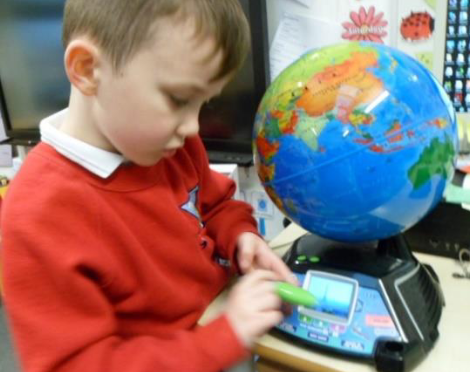
I want to learn about what’s on the globe.
|
Sometimes the things on photos are really small, so my teacher zooms in! |
Writing is challenging. It is difficult to put all the new words into sentences that make sense. My teacher does partner talk which helps.
|
The final task – trying to remember all the facts I have learnt. It is tricky to write up all the words into sentences. It helps to reread the booklets. |
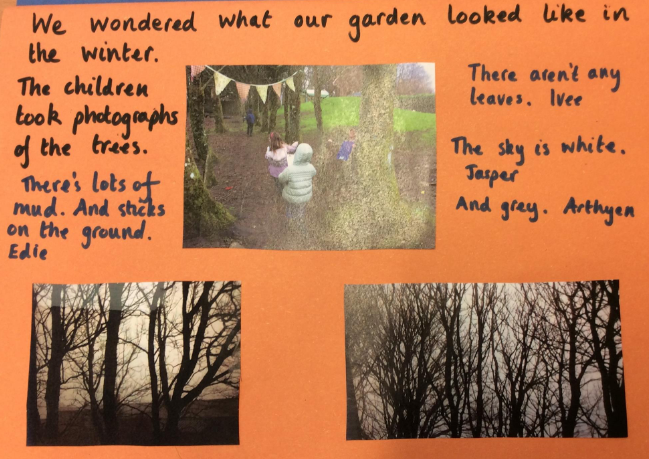
Early Years Foundation Stage
Learning about 'Wonderful Winter'.
Key Stage 1
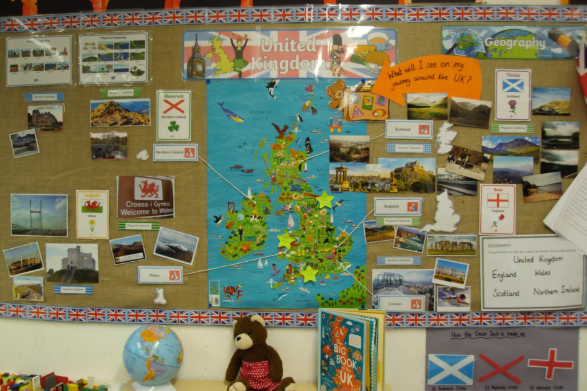
Barnaby Bear's Adventures around the UK.
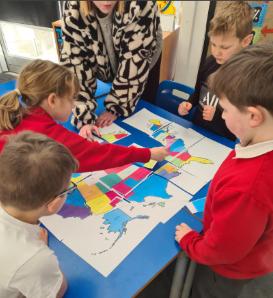
Learning all about the four countries of the United Kingdom.
Trevone Class Weather Forecasts
Years 1 and 2 have enjoyed learning about the different types of weather.
They then worked in groups to present a weather forecast, where they talked about the 4 countries of the United Kingdom and what the weather was like.
Lundy Class Weather Forecasts
We hope you enjoy watching them.
We definitely have some future weather presenters at Camelford Primary!
Lower Key Stage 2
The Mysterious Mayans
Exploring North and South America, including Mesoamerica where the Maya began.
Upper Key Stage 2
Ice Worlds
Developing knowledge of Antarctica and the wider world.